
Introduction to Sentence, Subject, Object and Extension – English Grammar (Bangla Guide)
Published on October 18, 2026
Introduction to Sentence, Subject, Object and Extension
Understanding how to form correct English sentences is crucial for Bangladeshi SSC/HSC students. In a sentence (বাক্য), every idea has a subject (কর্তা) who does something and often an object (কর্ম) that receives the action. We will explain what a sentence is, define subject and object, and introduce extension (অতিরিক্ত তথ্য) – the extra detail (like place, time or reason) that makes sentences more interesting. All explanations will include Bangla meanings to help learners.
What Is a Sentence? (বাক্য কী?)
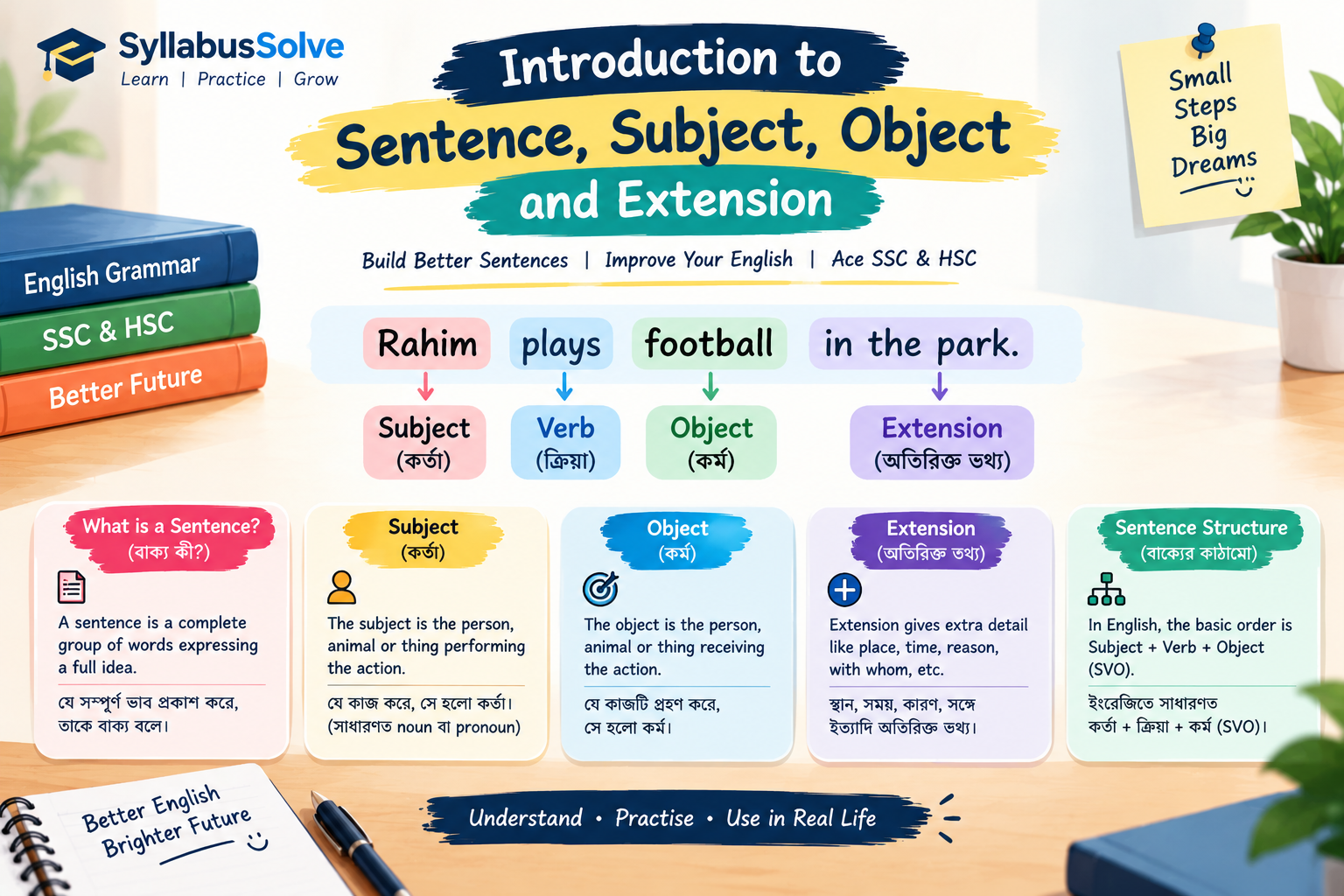
A sentence is a complete group of words expressing a full idea. For example, “She reads a book.” (সে একটি বই পড়ে।) is a sentence because it tells a whole thought: who does what. In English, every sentence starts with a capital letter and ends with a period (.) or question mark. Importantly, every sentence has two main parts: the subject and the predicate. The subject tells who or what the sentence is about, and the predicate tells what the subject does or is.
What Is a Subject? (কর্তা কী?)
The subject (কর্তা) is the person, animal, or thing performing the action in the sentence. It is usually a noun or pronoun. For example, in the sentence “Rahim plays cricket.”, Rahim is the subject (রহিম ক্রিকেট খেলে) because he does the playing. In Bangla we also call this the “কর্তা”. Another example: “The sun rises.” (সূর্য ওঠে।) – here The sun (সূর্য) is the subject.
What Is an Object? (কর্ম কী?)
The object (কর্ম) is the person, animal, or thing receiving the action. It often comes after the verb. For instance, in “She reads a book.” (সে একটি বই পড়ে।), a book (বই) is the object because it receives the action of reading. Objects can be direct (মুখ্য কর্ম) or indirect (গৌণ কর্ম). In “I gave her (indirect) a letter (direct).” (আমি তাকে একটি চিঠি দিলাম।), “her” is the indirect object (to whom), and “a letter” is the direct object (what was given).
Sentence Structure (বাক্যের কাঠামো)
In English, the basic word order is Subject + Verb + Object (SVO). This is different from Bangla, which is generally Subject + Object + Verb. In Bangla we say “আমি ভাত খাই” (I rice eat), but in English we say “I eat rice.” (আমি ভাত খাই), placing the verb right after the subject. This SVO order is fundamental – the verb cannot go at the very end as in Bangla. For example, “Karim called Rahim” means a different action than “Rahim called Karim” in English, so word order is critical. A quick rule: usually keep the Subject, Verb, and Object in that order.
What Is Extension (অতিরিক্ত তথ্য)?
An extension (অতিরিক্ত তথ্য) is extra information added to a sentence to tell where, when, how, with whom, or why something happens. Extensions answer questions like “Where?”, “When?”, “How?”, etc. For example, in “The children play football in the park,” the phrase “in the park” is a place extension answering where they play. Similarly, “He studies at night” adds a time extension. Adding extensions makes sentences longer and more informative.
Building Larger Sentences
Start with a simple S+V+O sentence and then add extensions one by one. For example:
Basic: “They study.” (তারা পড়াশোনা করে।) – S+V only.
Add Place: “They study in Dhaka.” (তারা ঢাকায় পড়াশোনা করে।) – added place.
Add Time: “They study in Dhaka every day.” (তারা প্রতিদিন ঢাকায় পড়াশোনা করে।) – added time.
Add With-whom: “They study in Dhaka every day with their friends.” (তারা প্রতিদিন ঢাকায় বন্ধুদের সঙ্গে পড়াশোনা করে।) – added company.
Each added extension enriches the sentence without changing the core meaning.
Changing Forms
You can make positive, negative, or question forms while keeping the Subject and Object. For example, “They play football” (তারা ফুটবল খেলে) becomes “They do not play football” (তারা ফুটবল খেলে না) in the negative, and “Do they play football?” (তারা কি ফুটবল খেলে?) as a question. The core SVO stays, while the verb form or auxiliary changes.
Practice Exercises
Identify the subject, object, and extension in each sentence, or expand sentences with extensions. (Answers are given below.)
Sentence: “Students read books in the library.” – Subject? Object? Extension?
Task: Expand “She sings” by adding a time and place extension (e.g. “in the morning, at school”).
Identify: “We will visit Cox’s Bazar next summer.” – What is the subject, object, and extension?
Rewrite: Change “Ali plays football” into a question sentence.
Fill in: “The Titas River ______ (flow) through Dhaka every day.” (Fill in the correct verb form.)
Answers
Subject = Students (শিক্ষার্থীরা), Object = books (বই), Extension = in the library (লাইব্রেরিতে).
Possible answer: “She sings in the morning at school.” (সকালে স্কুলে সে গান গায়।)
Subject = We (আমরা), Object = Cox’s Bazar, Extension = next summer (আগামী গ্রীষ্মে). Note: “Cox’s Bazar” is the object of “visit”; it is also a place name, but grammatically it functions as the object here.
“Does Ali play football?” (আলি কি ফুটবল খেলে?)
“The Titas River flows through Dhaka every day.” (তিতাস নদী প্রতিদিন ঢাকার মধ্য দিয়ে বয়ে যায়।)
For more practice with sentence parts and word usage, see our Word Practice in English Grammar guide.
Conclusion
Mastering sentences means knowing the roles of the subject, object, and how to extend ideas. Start with the Subject-Verb-Object structure where appropriate, then add details. With regular practice and attention to Bangla-English differences, Bangladeshi students can write clearer English sentences.
Frequently Asked Questions
What is the basic English word order?
English generally follows Subject + Verb + Object (SVO) order. For example, She (subject) reads (verb) books (object).
What is an extension in a sentence?
An extension (অতিরিক্ত তথ্য) adds extra detail, such as place or time, to a sentence. It answers questions such as where, when, and how.
How do I find the object?
The object often follows the verb and receives the action. In “I eat rice,” rice is the object (ভাত)।